
Given the physical nature of contact rugby and the severity of concussion injuries, it is extremely important to understand what a concussion is, how to recognize the signs and symptoms, the proper protocol for diagnosis and treatment, and where to find key resources.
What is a concussion?
Concussions are the most common form of mild traumatic brain injury and occur after a blow to the head, face, neck, or body, or from a whiplash-type injury that results in rapid head movement. Concussions result in an immediate or delayed onset of cognitive, physical, emotional, and fatigue-based symptoms, which lead to millions of lost days of work, school, and rugby.
Why is it important to become educated about concussions?
Recognizing concussions is the collective effort of everyone involved with rugby, including players, teammates, coaches, match officials, parents/guardians, and spectators. Research shows that concussions often go unreported due to the unsureness of symptom severity from players, coaches, and other participants. Athletes also avoid reporting due wanting to continue playing, not wanting to let anyone down, and feeling pressure to ‘tough it out’. However, when participants have concussion education and play in a wellbeing-centred environment, self-reporting and recognition rates increase. Creating a strong knowledge basis of concussion information and protocols are key to keeping all rugby participants safe on and off of the pitch!
How do you recognize a concussion?
Concussion symptoms can begin immediately after injury, with or without the individual losing consciousness, or may appear 1-2 days later. Concussion symptoms can vary in severity, and the Concussion Recognition Tool can help you recognize common, red-flag, and other signs of a concussion that require monitoring or action.
What are the symptoms of a concussion?
- Red flag symptoms require immediate action and include confusion, worsening headaches, vomiting, seizures, trouble walking or talking, or abnormal behaviours. If these occur after an injury, individuals should be taken to the doctor or hospital as soon as possible.
- Other common symptoms include headache, dizziness, nausea, blurred vision, light or noise sensitivity, balance problems, reduced exercise tolerance, lethargy, memory problems, difficulty focusing, heightened emotional state, abnormal sleep patterns, or difficulty falling or staying asleep.
How to diagnose a concussion?
Since concussions vary in severity and no single scan can diagnose a concussion, it is important to get a formal assessment from a doctor to identify symptoms, provide an official diagnosis, and create a personalized treatment plan. Most concussion symptoms dissipate within 2-4 weeks; however, in some cases, symptoms can persist longer, especially when recovery is not managed properly. It is important to rest and recover before returning to play to limit the possibility of second impact syndrome and lasting effects or brain damage.
What do I do after receiving a concussion diagnosis?
Individuals who have a concussion should be removed from play immediately. Using Rugby Ontario’s Blue Card Process, individuals will be flagged within the PlayHQ system until the individual completes the Graduated Return to Play Protocol and are cleared by a doctor using the Medical Clearance Letter, which must be submitted to Rugby Ontario before returning to play.
Additional Concussion Resources
- Development Mini-Series: Concussion Management and Safety
- Living Guideline for Pediatric Concussion
- 360 Concussion Care
- Transcendent Concussion Research Program
- Parachute Concussion
- World Rugby Concussion Guidance
- World Rugby Concussion Management for the General Public
- Concussion Awareness
- Brain Injury Canada Concussion Recovery
Rowan’s Law legislation was passed by the Ontario Government in 2018. This legislation is named in memory of Rowan Stringer who tragically died in 2013 of Second Impact Syndrome, the result of suffering multiple concussion playing rugby three times in six days. The legislation is designed to create a safer environment for competitive amateur athletes, children and youth to play sport.
The Ontario Government and Rugby Ontario are committed to implementing Rowan’s Law by putting concussion safety information in the hands of people who need it most.
What is Rugby Ontario Doing?
- All registrants are required to review and sign off on the Ontario Ministry’s Concussion Awareness Resources and the Rugby Ontario Concussion Code of Conduct for Players. If the registrant is under 18 years of age, then their parent/guardian must sign off.
- Rugby Ontario requires all registered coaches, match officials and medical staff to provide them with and sign off on the Ontario Ministry’s Concussion awareness resources and the Rugby Ontario Concussion Code of Conduct for Coaches and Team Trainers.
- Rugby Ontario works with Rugby Canada and PlayHQ to build the necessary Government requirements under Rowan’s Law into the online registration process.
Rowan’s Law Resources
Enhancing player safety and game welfare is a primary concern and responsibility of Rugby Canada and Rugby Ontario. Consequently, all matches played under the jurisdiction of Rugby Canada and the provincial unions must comply with Rugby Canada Concussion Guidelines (recognize and remove). To assist in player safety and game welfare, Rugby Canada and Rugby Ontario has rolled out the Blue Card at all levels of the game in Ontario.
The Blue Card is a process initiated by a coach, player or match official and delivered on field by the Match Official to identify a player who has been removed from the field of play due to a suspected concussion in accordance with Law 3.22 or Law 3.24. The Match Official or designate will submit a Blue Card Report in PlayHQ which will trigger a process to ensure the correct return to play protocols are followed.
All member clubs will designate a Blue Card Officer(s) to ensure that the process is followed for all rugby activities within their club.
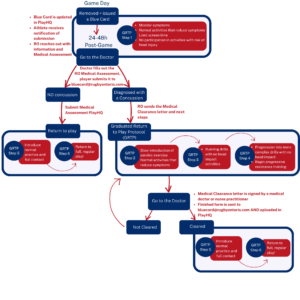
- When a player is removed from the field of play for a suspected concussion, the match official or designated individual will issue that player with a “Blue Card”, in a similar manner to which a red or yellow card is issued.
- The player is required to leave the field of play immediately and cannot return to play in that match. Please note in accordance with World Rugby and Rugby Canada direction, there is no sideline Head Injury Assessment (HIA) process at any level of Club rugby.
- The match official includes the issuing of the Blue Card in their match report.
- The player and their club receive an email notification from Rugby Ontario of the issuing of the Blue Card and the required process to the followed (Appendix C).
- The player issued with the Blue Card cannot return to play in any future match without first receiving a written medical clearance via either the Medical Assessment Letter or Medical Clearance letter*, signed by a Physician (MD) or Nurse Practitioner (NP), meeting the requirements of Rowan’s Law, the World Rugby Return to Play Protocols and receiving a written clearance from Rugby Ontario to return to play.
*Note: Doctor’s notes cannot be accepted, clearance must be completed via either letter mentioned and linked above.
All member clubs will designate a Blue Card Officer(s) to ensure that the process is followed for all rugby activities within their club.
For rugby activities without a Match Official, coaches or administrators will notify Rugby Ontario via issuing a Blue Card via PlayHQ Concussion Management Records, or if not available, contacting Rugby Ontario at bluecard@rugbyontario.com
Blue Card and Return to Play Process Flowchart
PlayHQ Resources
Blue Card Education
- Blue Card E-Learning – English and French